
The SuperStar Project - No. 9
Hero Numbers! (with all sortsa caveats)

Some years ago, in the pursuit of a book that I didn’t wind up writing (let alone selling to a publisher), I generated a LONG LIST of stardom indicators (or lack of a better term, which I might or might not have come up with at the time).
How long? My book proposal listed 29 … okay, I just checked the proposal and I called them superstar markers. Maybe that’s why it didn’t sell. Anyway, one of those markers was what I called hero numbers on the backs of baseball cards.
I might even have a draft chapter about them — in longhand, on a legal pad somewhere — but I didn’t actually compile any numbers until last week. Hence, this thing you’re reading, so I can move along to something even less important…
Caveat No. 1: Just Topps.
Caveat No. 2: Just Topps 1952 through 1985.
Caveat No. 3: Aw hell, if you want more caveats you gotta keep reading.
So again, some years ago I hit upon the idea of using (Topps) baseball-card numbers as an indicator of baseball players’ stardom.
Some years before that, our friend Joe Posnanski hit upon the idea first (or at least before I did). Before I launch into my thing, a few words about Joe’s thing (which you can read for yourself right here)…
Joe’s study went longer than mine, 1952 through (I think) 2012.
My research ended at 1985 because I was using this incredible book, which (I can’t believe!) is now almost 40 years old (and yes, I know I could have done the next (almost) 40 years on the internet, but I could not bear all the necessary clicking).
If you haven’t already read Joe’s essay, he went through all those years and counted the cards with numbers ending in 00 or 50. He calls those Topps Prime, and came up with a scoring system (which is exactly what I should do, but haven’t). He also started counting — beginning in 1990 — No. 1 cards, because “Topps started giving a superstar the cherished №1 card.”
Which is a little weird, because Topps actually gave superstars No. 1 cards well before 1990. Routinely. Which I’m sure Joe must have noticed. Only thing I can figure is he left out this information so I’d still have something to write about.
Beginning in 1952, here are the No. 1’s for a good stretch:
1952: Andy Pafko
1953: Jackie Robinson
1954: Ted Williams
1955: Dusty Rhodes
1956: Will Harridge
1957: Ted Williams
1958: Ted Williams
1959: Ford Frick
1960: Early Wynn
1961: Dick Groat
1962: Roger Maris
Pafko was a good player, but hardly a superstar. There might have been a good reason for giving him the first card in Topps’s first classic set, but I haven’t discerned such a reason; he’d been a four-time All-Star, but hadn’t been particularly good in 1951.
Then you have Jackie Robinson and Ted Williams. Enough said. Dusty Rhodes became famous because of his pinch-hitting feats in the 1954 World Series. Will Harridge was president of the American League, and they gave the No. 2 card that year to Warren Giles, his N.L. counterpart. Then more Teddy Ballgame. Then the commissioner, Ford Frick. Then three superstars in a row, with Groat and Maris having won MVP Awards in the previous season.
Then for the next 27 years, it was nearly always league leaders, record breakers, or championship teams … except Willie Mays was No. 1 in 1966, and Hank Aaron in 1974. Finally, in 1990 we got Nolan Ryan with No. 1 (and how I used to enjoy looking at the back of that card, with its tiny voluminous type).
Somehow Joe seems to have missed those 1950s No. 1’s.
I think he also missed the important No. 2’s:
1955: Ted Williams
1956: Warren Giles (not important)
1957: Yogi Berra
1958: Bob Lemon
1959: Eddie Yost (not important)
1960: Roman Mejias (ditto)
1961: Roger Maris
1962: Jim Brosnan (respect!)
That list points to something about Topps’s numbering systems over the years, which Joe also pointed out: THEY WERE INCONSISTENT. How do you go from Roman Mejias one year to MVP Roger Maris the next? Well, they did it!
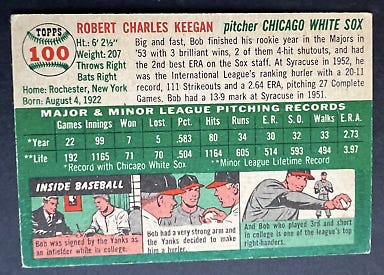
Here’s another thing they did. From 1954 through ‘58, here were the numbers for Bob Keegan’s cards:
100, 10, 54, 99, 200
Bob Keegan was a pretty good pitcher, but three hero numbers in five years?
No, Joe Posnanski didn’t count 10 as Topps Prime, but here’s a list of 10s:
1953: Smokey Burgess
1954: Jackie Robinson
1955: Bob Keegan
1956: Warren Spahn
1957: Willie Mays
1958: Lou Burdette
1959: Mickey Mantle
1960: Ernie Banks
1961: Brooks Robinson
1962: Bob Clemente (as named on card)
Robert Charles Keegan either lucked his way into three hero numbers, or he had a good friend at Topps.
Anyway, if I can add anything to Joe’s analysis, it’s that 1’s and 2’s meant something in the 1950s (and occasionally later, not just beginning in 1990) … and also that 10, 20, 30, and 40 were also really meaningful for quite some time.
Joe did mention this, if obliquely: “It isn’t just 00 and 50 cards that are reserved for good players. Even minor stars almost always have numbers that end in 0 as well.”
That was true when I collected in the middle ‘80s. Or at least that’s how I remember it. But I believe that in any system that gives points for card numbers, you have to account for the tendency to give 10-20-30-40 cards to superstars until at least the ‘80s (when I stopped checking). Just for example, here’s a partial list of 40s:
Early Wynn, George Kell, Warren Spahn, Orlando Cepeda, Dick Groat, Jim Grant, Rick Reichardt, Denny McLain, Rich Allen, Reggie Smith, Jim Palmer, Dave Kingman, Bobby Murcer, Carl Yastrzemski, Steve Carlton, Carlton Fisk, Dave Parker, Fernando Valenzuela, Phil Niekro
Superstars? Some yes, most no. Big stars? I think there are 11 Hall of Famers in there. All of them were pretty famous, even Rick Reichardt (IYKYK).
All I’m saying is, those low cards ending in 0 seem to have been more prestigious than, say, your 370s and 620s of the world. Granted, I haven’t checked. Pretty sure though.
If you want to check for yourself, go ahead. I started by doing what Joe did: looking up all the cards ending in 00 and 50. But I’d see those on the page and notice something else, and that would lead to something else … and so I wound up tracking those, plus all the 1’s and 2’s and 20s and 30s and 40s, too.
You can see for yourself if you want, in this shared spreadsheet that includes some shading and color-coding of my own, the reasons for which I’m sure you can discern.
And if you can somehow explain Bob Barton to me, I shall remain forever in your debt.
Thanks for reading! On to the next pointless exercise!
Kids would usually organize their cards numerically. So the #1's were on the top, where they took a beating, esp. with a rubber band often creasing them.
It's hard to find #1's in mint condition.
Fun piece Rob, but you underestimate Andy Pafko. He was coming off back-to-back 30 HR seasons in 1952.