
Why, yes, it does. It very much does go.
exploring another climbing quote

“It goes, boys!”
- Lynn Hill, 1993
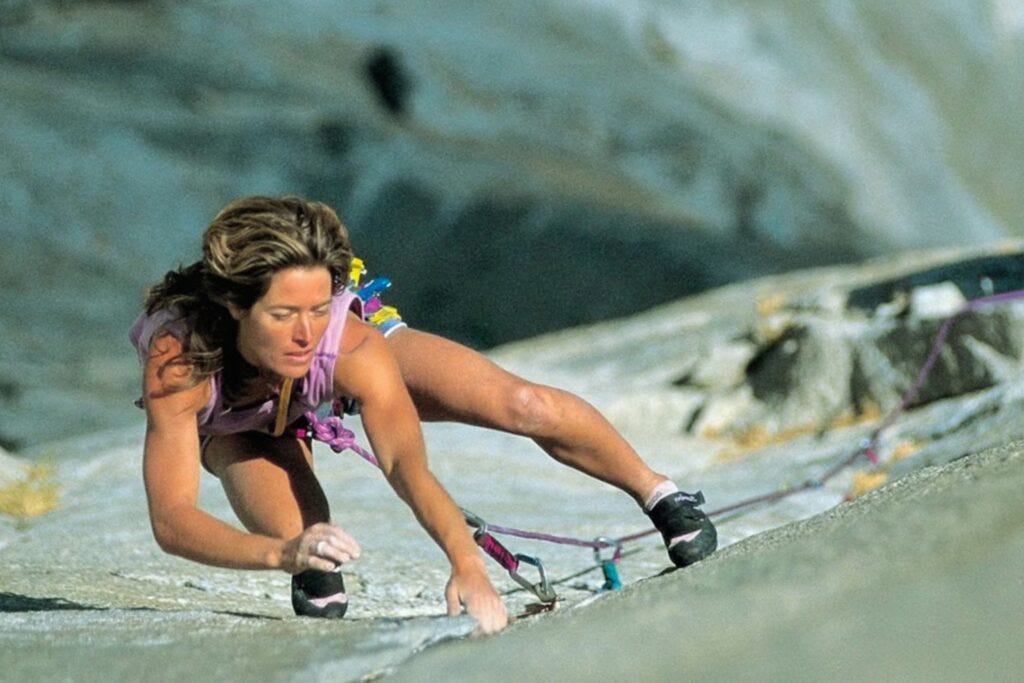
Yesterday some of you might have wondered why that dastardly Tribout got his own essay, while Lynn Hill, who’s the hero in that story, does not.
Well, now you know: She does.
Which isn’t to suggest that a short chapter or two can tell the story of Hill’s life or greatness, let alone what makes her tick; for that, you should read Climbing Free, her engaging 2002 memoir (written with Greg Child, a tremendously talented climber, writer, and filmmaker in his own right).
Just a few things that might, if you don’t already know Hill’s story, surprise you about one of our greatest rock climbers…
While most climbers are thought of as both wiry and reasonably tall or at least long-limbed – the better to reach for that distant hold – Hill has described herself as “five-one-and-a-half.”1
In the early ‘80s you could not make a living as a rock-climber. Among Hill’s jobs in those years, while she was attending various universities, were a variety of TV appearances: she was a four-time winner of NBC’s Survival of the Fittest competition, and also showed up on The Guinness Game, Ripley’s Believe It or Not, and That’s Incredible!2
In 1980, her brother-in-law Chuck Bludworth (also a climber) disappeared while attempting a first ascent of Aconcagua’s south face; 25 years later, Hill’s friend Hugues Beauzile perished in nearly the same spot.
In 1989 while climbing in France, with her then-husband belaying, Hill forgot to tie into her end of the rope. After reaching the top of a warmup route, she let go and plummeted 72 feet. But a tree slowed her descent and she hit the (relatively soft) ground between two boulders, and so escaped with just a dislocated elbow and a broken bone in her foot. Six weeks later she was climbing, and soon ranked again among the world’s top competitive climbers.
But for most of her life now, she’s been most famous for becoming, in 1993, the first human to free-climb the climbing world’s most iconic route, The Nose, on America’s most iconic piece of rock, Yosemite’s El Capitan. All 3,000 feet of it.
Hill had stopped competing in Europe, and at that point there weren’t many opportunities for climbers to otherwise make a living. So going for The Nose was, she said in 2022 on the Nugget Climbing Podcast, “a little bit of a retirement gesture. I thought, ‘Well, I’ve been training and climbing for competitions. I’m not doing that any more, but maybe I can do something really special on the rock that combines all of my skills … So that was my motivation for trying to do the masterpiece climb.”
That took her and partner Brooke Sandahl—who did not “free” the two most difficult sections—a few days on the wall (which included “camping” on the wall, in special gear tethered to the rock).
(In 1994, perhaps even more incredibly, Hill went back and “freed” The Nose in 23 hours. And in case this hasn’t come up before, “free-climbing” means climbing without using anything except your own power to move up the wall; your rope and various gear is solely to keep you from falling.3)
Now, about that quote…
In a 2024 New York Times essay, world-class climber Sasha DiGiulian wrote, “... the very first free ascent of one of the hardest routes on El Cap, the Nose, was done by a woman, Lynn Hill, way back in 1993. Everyone said it was impossible. Then she did it. Afterward, in what could be construed as either an announcement or a challenge, she declared, ‘It goes, boys.’ ”
That sounds pretty definitive: sent the route in 1993; declared. And who better to relate the story than DiGiulian, who has become very close to Hill in recent years?
Well, Lynn Hill is probably better. Here’s what Hill said in a 2019 interview (with Kate Sedrowski for her “Cameras & Carabiners” website):
Sedrowski: “It goes, boys!” Was that planned or did that just come out?
Hill: It came out in a conversation with John Bachar. We were going up there to take pictures, because he was a part owner of Boreal shoes, and I was sponsored by Boreal.
So we’re taking pictures and he was just joking around saying, “Yeah, gee, some day some guy’s gonna climb that route.” And I don’t know if he said it, or I said it – I think he might’ve said, “It goes, boys!”
And then he heard the conversation, like, objectively, and said that would be a good ad. So that’s where it came from.
That is the most specific thing I’ve seen from Hill herself about the quote’s origins.
A year or so later, she told nearly the same story in another interview, but this time without partial attribution to her friend Bachar4:
Q: Lynn, what does the statement “It goes, boys!” mean for you and for the whole climbing community?
Hill: It means “It is possible, guys.” It was really interesting to be a woman and do the first ascent of something so historic and noteworthy. First of all, this sentence came up when John Bachar and I [were] talking. We were doing a photoshoot on the top of the El Capitan and we were just joking around. Usually, somebody says, “Yeah, some guy can free climb that.” That’s what you would usually hear. I have heard the narrative “that some guy will do that” all my life. The progress and first ascents have always been referred to in male terms. My summit statement back then was a sort of spin on that thinking pattern.
“It goes, boys.”
The choice for boys was sort of a funny encouragement for men. Young men.
In Climbing Free, published in 2002, Hill does not mention saying “It goes, boys.” Seven years later, in a long interview for an American Alpine Club project, it didn’t come up.
At this writing, though, if you visit Hill’s website and want to purchase something, your choices are mostly shirts and photos, all of them trumpeting, IT GOES BOYS!
But who said that first? It might have been Hill; it might have been Bachar.
Oh, and when? It might have been when Hill reached the top of the wall that first time with Sandahl—which is how the story is nearly always told now, if not by Hill herself—or it might have been later.
I think it was later.
Hill and Sandahl topped out on September 16, with the news first breaking in a two-page report in the December 1993/January 2024 issue of Climbing magazine. In that same issue, there’s a full-page advertisement for Boreal climbing shoes. At the top of the page, you see this text …
SOMEDAY, SOME GUY’S GONNA FREE THE NOSE
… which is easy to miss, because just below that, filling most of the page, you see a beautiful, perfectly composed photo of Hill clinging to the rock, presumably near the top of the route.5
And below that, a black box with the following text:
“IT GOES, BOYS!”
- Lynn Hill, September 16, 1993
And at the very bottom of the page, with a pair of climbing shoes nearby, this quote: “I had to learn every technique I’ve ever used to free The Nose. The Vectors worked perfectly.”
Good ad? Great ad!
The image of Hill on the wall was credited to Bachar, who presumably took the photo during that photoshoot Hill has mentioned multiple times. So unless the credit’s wrong, we know that Bachar was there when Hill reached the top that time. Due to the light in that image, and the fact that Hill has a) mentioned the photoshoot, and b) never said Bachar was there when she and Sandahl topped out on September 16, I now think there aren’t any photos of Hill actually on the wall that day; the other photos I’ve seen, both in Climbing Free and Climbing magazine, seem to have been shot by John McDonald on the same day Bachar was on top.
But we’ll never know exactly when Hill said It goes, boys!
Or even if she said it.
Again, I do think it was probably later (but not much later, given when that first ad appeared in Climbing), and I think Bachar might well have said it first.
Which doesn’t bother me at all. These last two chapters have been more about ideas than the where/when/who specifics.
Tribout’s “idea” was that women climbers would never do what the men could do.
His friend Lynn Hill’s idea was, “Oh yeah? We just did more. Now you try.”
And so the boys did. But it would be four years before another climber (Scott Burke) reached the top after free-climbing the whole Nose. It took him 261 days. Spread over three years.
In 2005, Tommy Caldwell and Beth Rodden free-climbed the route together over four days. Two days later, Caldwell got up the route in just 12 hours, and a few days later he did it in 11 hours, descended, then free-climbed a different El Cap route.
Yes, it does go. Boys, girls, whatever. You just gotta be a superhero.
We remember quotes not because of their underlying details. We remember them because of their meaning … which is why we forget (or don’t care) about the details, as those pesky little suckers often just get in the way of a good and memorable story.
Ape Index, you say? Whatever, Lynn Hill says. Sometimes being taller with bigger hands and longer fingers helps get you up the wall, and sometimes it does not.
“Survival of the Fittest” was a long-running feature in the show SportsWorld, NBC’s lesser-remembered version of ABC’s Wide World of Sports. According to Hill, the women’s competition ended because the producers couldn’t find anyone who could beat her.
Free climbing should not be confused with the much less common (and much more dangerous) free soloing, which is climbing without a rope; if you fall, there’s nothing to catch you except the ground (or if you’re lucky, a ledge or a tree or something). We’re all now familiar with free soloing because of Alex Honnold, but only a tiny percentage of climbers are willing to take that risk, except perhaps on the easiest routes, and even then maybe just once. Just to have done it.
We can’t ask Bachar for his account, as he died in 2009 while free-soloing near his home. I did reach out to Hill via her website, but have not heard back.
If you want to see the image, just head over to Hill’s website, where you can purchase signed prints in different sizes; I have one.